For people who make things
Score Studio
Where the thing your toy does gets written. Not generated from the audio, not a preset with the speed turned up. It is composed under the voice, by the person who recorded it.
Why it exists
Before Ferality I was making haptic patterns for my own audio, and the process was exhausting.
To score a ten-minute track in the Lovense app you essentially draw the whole pattern in one take, timing everything by hand and getting it right without mistakes. If something goes wrong, the work can need doing again.
Then came synchronisation. A listener had to line up the start of the audio and the start of the pattern themselves.
And then device compatibility. Different toys can want their own patterns, which turns one creative idea into a repetitive production task. With a catalogue of more than forty Lovense toys, that is an enormous amount of duplicated work.
None of this encourages experimentation. It is a barrier to making the thing you wanted to make.
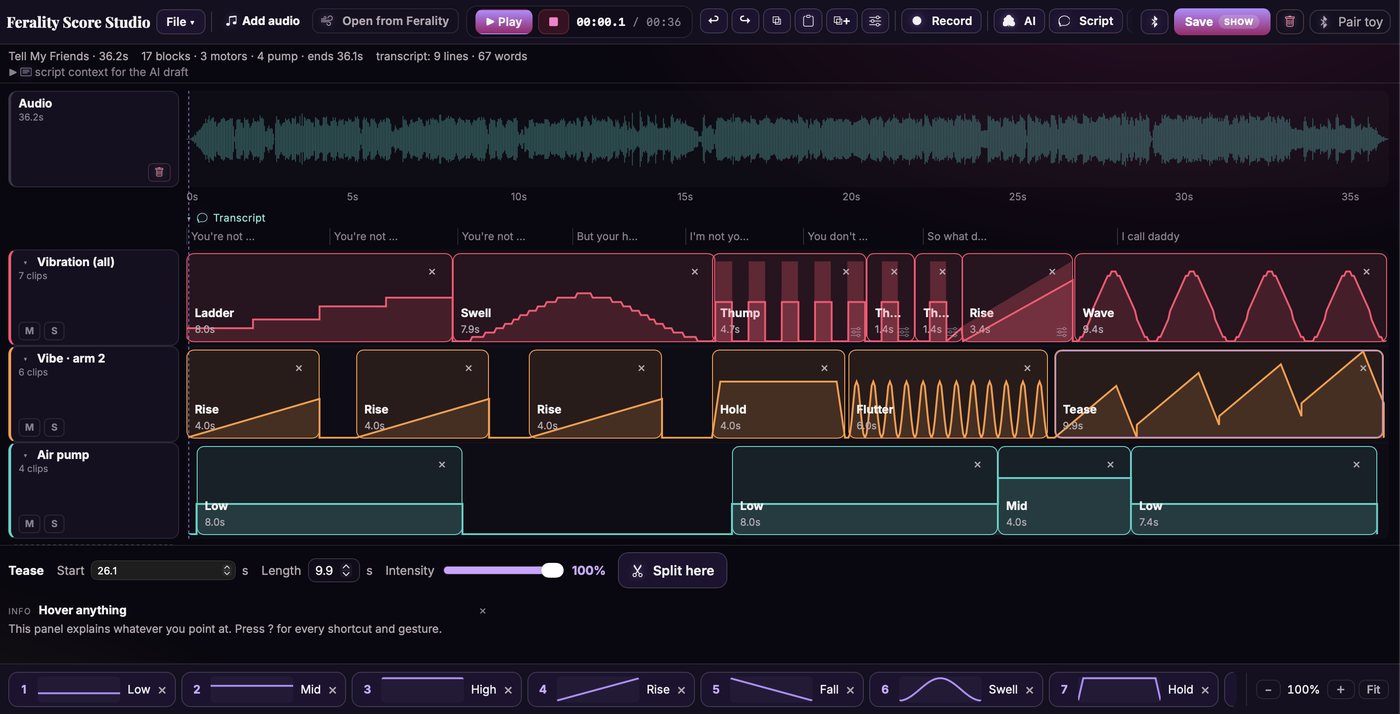
So I built Score Studio, a Digital Haptic Workstation. It takes its shape from Ableton Live, around a different idea: a haptic track is something you compose, edit and arrange as part of a production process, rather than a performance you have to execute perfectly in one take.
I did not want to keep a better workflow to myself. More about who makes this.
Why it is worth the trouble
- You score against the audio, hearing the words
- Studio opens your own Ferality audio and loads it, and the finished score comes back bound to that work. Authoring haptics to speech you cannot hear is guessing at timing, and that round trip is the whole reason it exists.
- Twelve lanes, not one buzz
- A multi-motor toy gets each motor routed separately; a single-motor toy feels the
strongest lane, so it is never silent while something else is driving.
VibrateVibrate1 Vibrate2Vibrate3 RotateThrusting DepthStroke FingeringSuction OscillatePump
- Step-held, never smoothed
- A level stays exactly where you put it until you change it. Interpolating between your events would be a different scene, not a prettier one. The engine plays what you wrote, and the drawings here hold the same rule.
- You never handle a file
- A finished score is pushed straight into your library on this site. There is no step where it exists as something to download, lose, or send to the wrong person. You attach it to one of your works from your Content page.
- You can re-score something already live
- Haptics change without going back through review and without taking the piece off the site, because a curve has no words in it. The record notes that it changed while published, so a work whose haptics moved after review says so forever.
- And you can switch them off
- A show whose haptics are off plays as plain audio for listeners, with the score still attached, so turning them back on needs no re-export.
Who can use it
Score Studio opens on a capability called haptics, and that one is granted by hand, one account at a time.
There is no upgrade button and nothing to buy. If you want to score your own work, ask. The Discord is the quickest way, and it is one person reading, so say what you are making.
The tool is named after what it writes. Nobody else in this niche calls the haptic track a score, and that is precisely why it is worth calling one.